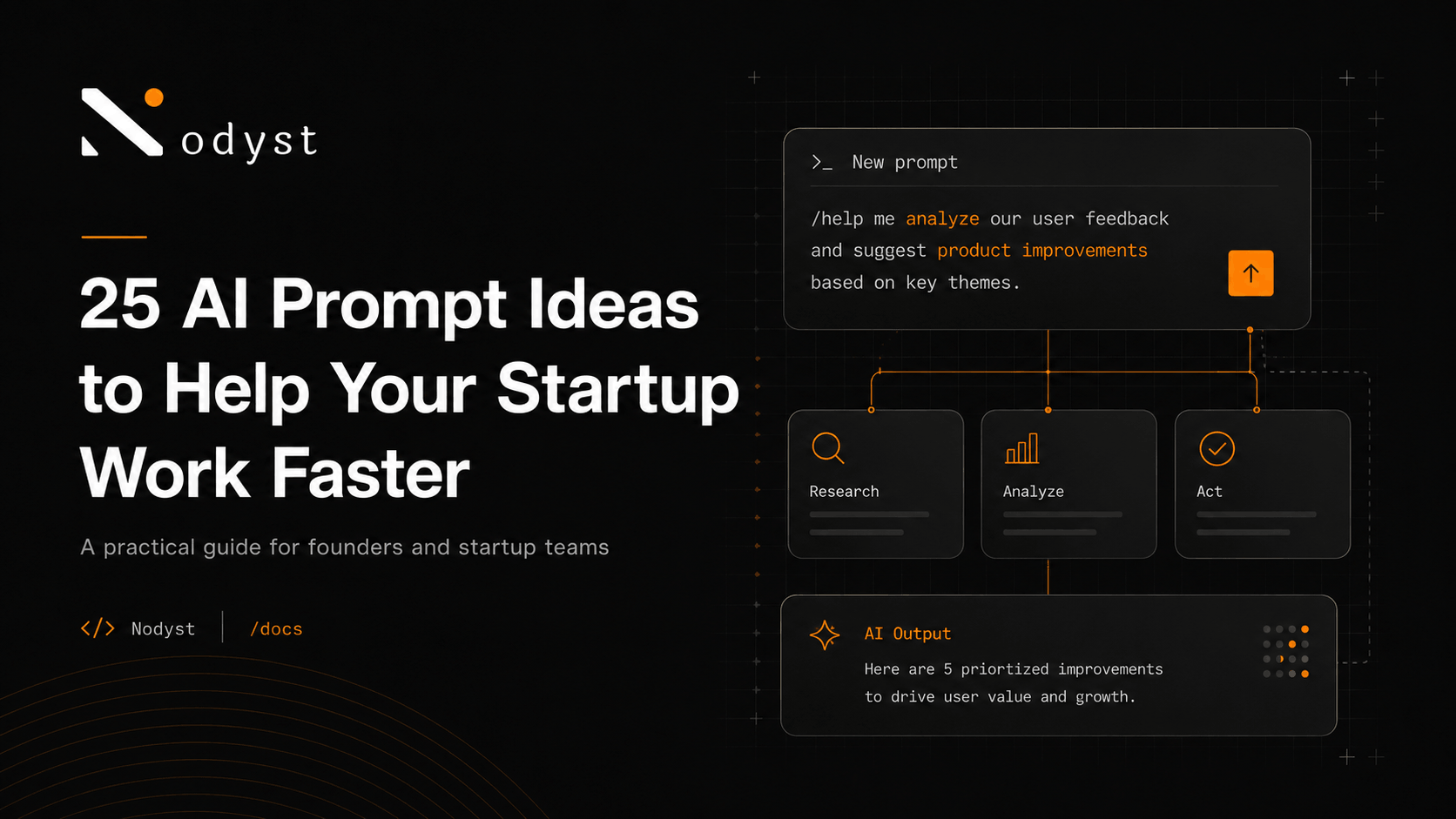
25 AI Prompt Ideas to Help Your Startup Work Faster
Artificial intelligence is becoming a standard part of the modern startup toolkit. Founders and small teams can use AI to accelerate research, clarify ideas, create content, analyze feedback, and reduce repetitive work.
The quality of the result, however, depends heavily on the quality of the prompt.
A useful prompt gives the AI clear context, defines the desired outcome, and specifies the format of the response. Instead of asking, “Give me marketing ideas,” a stronger prompt explains the product, audience, objective, constraints, and expected output.
Below are 25 practical AI prompts that startup teams can adapt for daily work.
Product Strategy
1. Evaluate a startup idea
Act as an early-stage startup advisor. Evaluate the following startup idea based on problem severity, target market, existing alternatives, differentiation, technical feasibility, monetization potential, and major risks. Identify the weakest assumptions and propose three ways to validate them before building the product.
Startup idea: [Describe the idea]
2. Define the minimum viable product
Help me define an MVP for the following product. Separate features into must-have, should-have, and future features. The MVP should test the main value proposition with the lowest reasonable development cost.
Product: [Describe the product] Target users: [Describe the users] Main problem: [Describe the problem]
3. Create a product roadmap
Create a six-month product roadmap for the following startup. Organize it by month and include product objectives, major features, technical priorities, user research activities, and success metrics.
Startup: [Describe the startup] Current stage: [Idea, prototype, beta, or launched] Team size: [Number and roles]
4. Identify risky assumptions
Review this business idea and list its most important assumptions. Categorize them as market, user, technical, financial, or operational assumptions. Rank them by impact and uncertainty, then suggest a low-cost experiment for testing each one.
Business idea: [Describe the idea]
5. Turn feedback into features
Analyze the following customer feedback. Group similar comments, identify recurring problems, distinguish feature requests from underlying needs, and recommend which issues should be prioritized.
Customer feedback: [Paste feedback]
Market Research
6. Create a customer persona
Build a detailed customer persona for the following product. Include demographics, goals, frustrations, current alternatives, buying motivations, objections, and the situations that would cause the person to search for this product.
Product: [Describe the product] Target market: [Describe the market]
7. Analyze competitors
Create a competitor analysis for the following startup. Compare direct and indirect competitors across target audience, value proposition, pricing, strengths, weaknesses, distribution, and differentiation. End with opportunities the startup could use to stand out.
Startup: [Describe the startup] Known competitors: [List competitors]
8. Generate customer interview questions
Create 15 unbiased customer discovery questions for people experiencing the following problem. Avoid leading questions and avoid asking whether they would use or buy the product. Focus on past behavior, current workflows, frustrations, spending, and decision-making.
Problem: [Describe the problem]
9. Estimate market segments
Break the following market into meaningful customer segments. For each segment, explain its needs, purchasing behavior, urgency, willingness to pay, and difficulty of acquisition. Recommend the best initial segment for an early-stage startup.
Market: [Describe the market]
10. Analyze industry trends
Identify the major trends affecting the following industry. For each trend, explain the opportunity, possible threat, expected time horizon, and how a startup could respond.
Industry: [Name the industry]
Branding and Positioning
11. Develop a value proposition
Write five clear value proposition options for the following product. Each option should explain who the product is for, what problem it solves, and why it is better than the current alternative. Avoid vague claims and unnecessary buzzwords.
Product: [Describe the product] Audience: [Describe the audience] Main benefit: [Describe the benefit]
12. Generate startup names
Generate 30 brandable names for a startup in the following category. Prioritize names that are short, easy to pronounce, easy to spell, and flexible enough for future expansion. Group the names by style and explain the reasoning behind the strongest five.
Category: [Describe the category] Brand personality: [Describe the desired personality] Words to avoid: [List words]
13. Define a brand voice
Create a brand voice guide for the following startup. Include personality traits, writing principles, preferred vocabulary, words to avoid, and examples of how the brand should sound on a website, in an email, and on social media.
Startup: [Describe the startup] Audience: [Describe the audience] Desired perception: [Describe the perception]
14. Write a positioning statement
Create a positioning statement using this structure: For [target customer], [product] is the [category] that [primary benefit] because [reason to believe]. Provide five variations ranging from practical to ambitious.
Product details: [Describe the product]
15. Create a startup elevator pitch
Write a 30-second elevator pitch for the following startup. Explain the problem, solution, target user, differentiation, and business opportunity using clear language that a non-technical person can understand.
Startup: [Describe the startup]
Marketing and Content
16. Generate blog post ideas
Generate 30 blog post ideas for a startup that provides [product or service]. Organize the ideas by awareness, education, comparison, conversion, and customer success. Include a proposed headline and the main search intent for each idea.
17. Build a content calendar
Create a four-week content calendar for the following startup. Include three posts per week across blog, LinkedIn, Instagram, or email. For each post, provide the topic, format, audience, objective, hook, and call to action.
Startup: [Describe the startup] Marketing goal: [Describe the goal]
18. Improve a landing page
Review the following landing page copy. Identify unclear claims, weak sections, missing information, unnecessary jargon, and potential objections. Then rewrite the page with a stronger headline, supporting copy, benefits, social proof placeholders, and call to action.
Landing page copy: [Paste copy]
19. Create social media posts
Create 10 social media posts promoting the following product. Use a mix of educational, problem-focused, product-focused, founder-led, and customer-focused content. Each post should include a strong opening line and a clear call to action.
Product: [Describe the product] Platform: [LinkedIn, Instagram, X, or another platform]
20. Write an email launch sequence
Create a five-email launch sequence for the following product. Include an announcement email, problem-awareness email, product education email, objection-handling email, and final call-to-action email.
Product: [Describe the product] Audience: [Describe the audience] Launch offer: [Describe the offer]
Operations and Growth
21. Create standard operating procedures
Turn the following workflow into a clear standard operating procedure. Include the purpose, required tools, responsible roles, step-by-step instructions, quality checks, common failure points, and escalation process.
Workflow: [Describe the workflow]
22. Analyze startup metrics
Analyze the following startup metrics. Identify positive trends, warning signs, missing information, and likely causes. Recommend the three most important actions the team should take next.
Metrics: [Paste the metrics] Business model: [Describe the business model]
23. Prioritize tasks
Review the following startup task list. Rank each task based on user impact, business impact, urgency, effort, dependencies, and risk. Create a prioritized action plan for the next two weeks.
Tasks: [Paste task list]
24. Prepare for an investor meeting
Act as a skeptical early-stage investor. Review the following startup description and generate 20 difficult questions about the market, traction, product, competition, business model, team, financial assumptions, and risks. Then suggest strong evidence-based answers.
Startup description: [Describe the startup]
25. Run a startup retrospective
Facilitate a retrospective for the following startup project. Organize the analysis into what worked, what failed, what was learned, unresolved problems, and concrete changes for the next cycle. Distinguish between symptoms and root causes.
Project summary: [Describe the project]
A Simple Prompt Framework
You can improve most prompts by including five elements:
- Role: Define the perspective the AI should adopt.
- Context: Explain the product, audience, and situation.
- Task: State exactly what you need.
- Constraints: Specify limitations, priorities, and what to avoid.
- Format: Describe how the response should be structured.
For example:
Act as a SaaS product marketer. Create a landing page outline for a project-management platform designed for small construction companies. Focus on reducing scheduling errors and improving communication between field teams and office staff. Avoid generic productivity claims. Include a headline, subheading, three benefits, objection handling, and one call to action.
This prompt will usually produce a more useful result than:
Write a landing page for my app.
Final Considerations
AI should support startup decision-making, not replace it. Outputs should be treated as drafts, hypotheses, and structured starting points. Market claims should be verified, customer insights should come from real users, and strategic decisions should remain grounded in evidence.
The strongest startup teams use AI to move faster while maintaining disciplined judgment. A well-written prompt can reduce the time required to explore an idea, but execution, validation, and customer understanding still determine whether the idea succeeds.